
Did you know that by 2026, over 70% of common medical concerns in Winnipeg are resolved through virtual platforms? As digital health becomes the standard for everything from prescription renewals to sick notes, many patients still wonder: is virtual care in Winnipeg secure? It’s a valid concern, especially if you’re worried about where your data lives or if a video call is as private as a traditional exam room.
You deserve to feel confident that your medical history isn’t at risk of identity theft. We understand that general apps like FaceTime aren’t built for healthcare, and you shouldn’t have to guess how your information is handled. This guide explains how Manitoba’s strict Personal Health Information Act (PHIA) and advanced 256-bit encryption ensure your consultations remain 100% confidential. We will break down the “Canadian soil” rule for data residency and provide simple steps you can take to secure your own home connection. You’ll gain the clarity and confidence needed to book your next virtual appointment with total peace of mind.
Key Takeaways
- Understand how the Personal Health Information Act (PHIA) defines your digital “circle of care” to keep records private among authorized providers.
- Explore the technical requirements of the “Canadian Soil” rule and why keeping your data within the country is a non-negotiable safety standard.
- Determine if is virtual care in winnipeg secure by reviewing the bank-grade encryption protocols used to shield your video consultations from unauthorized access.
- Access a 5-step privacy checklist to help you prepare a secure “Virtual Exam Room” in your own home before your next appointment.
- Learn how AskMyDoc maintains traditional medical ethics through rigorous security training for all licensed Manitoba doctors on the platform.
The State of Virtual Care Security in Winnipeg for 2026
Virtual care security is the digital equivalent of a locked exam room door. It combines high-level technical encryption with strict provincial regulations to keep your medical data private and unreachable by unauthorized parties. In 2026, this isn’t just a luxury; it’s a legal requirement for every online consultation. As more people move away from traditional waiting rooms, the question of whether is virtual care in winnipeg secure has become the top priority for patients. Security involves more than just a strong password. It encompasses how data is transmitted, where it is stored, and who has the legal right to view it.
The landscape has changed significantly since the early days of telehealth. While 2020 saw a rush to use any available video tool, 2026 standards demand dedicated clinical-grade platforms. These systems are built specifically for health data, unlike consumer messaging apps like WhatsApp or FaceTime. Clinical platforms use end-to-end encryption and store data on secure servers, ensuring your private conversations remain just that. Using a general app for a doctor’s visit is like discussing your health in a crowded coffee shop; it’s simply not designed for the level of privacy required for medical history.
Why Security Matters More in Healthcare
Personal Health Information (PHI) is incredibly sensitive. It includes your diagnostic orders, sick notes, and entire medical history. If this data is intercepted on a non-encrypted channel, it can lead to medical identity theft, which is much harder to resolve than a stolen credit card. Secure platforms use 256-bit AES encryption to scramble your data. This makes it unreadable to anyone without the proper key. It’s the same level of protection used by major banks. By preventing unauthorized access, these tools allow you to speak freely with your doctor about your most private concerns without fear of a data breach.
Winnipeg’s Digital Health Landscape
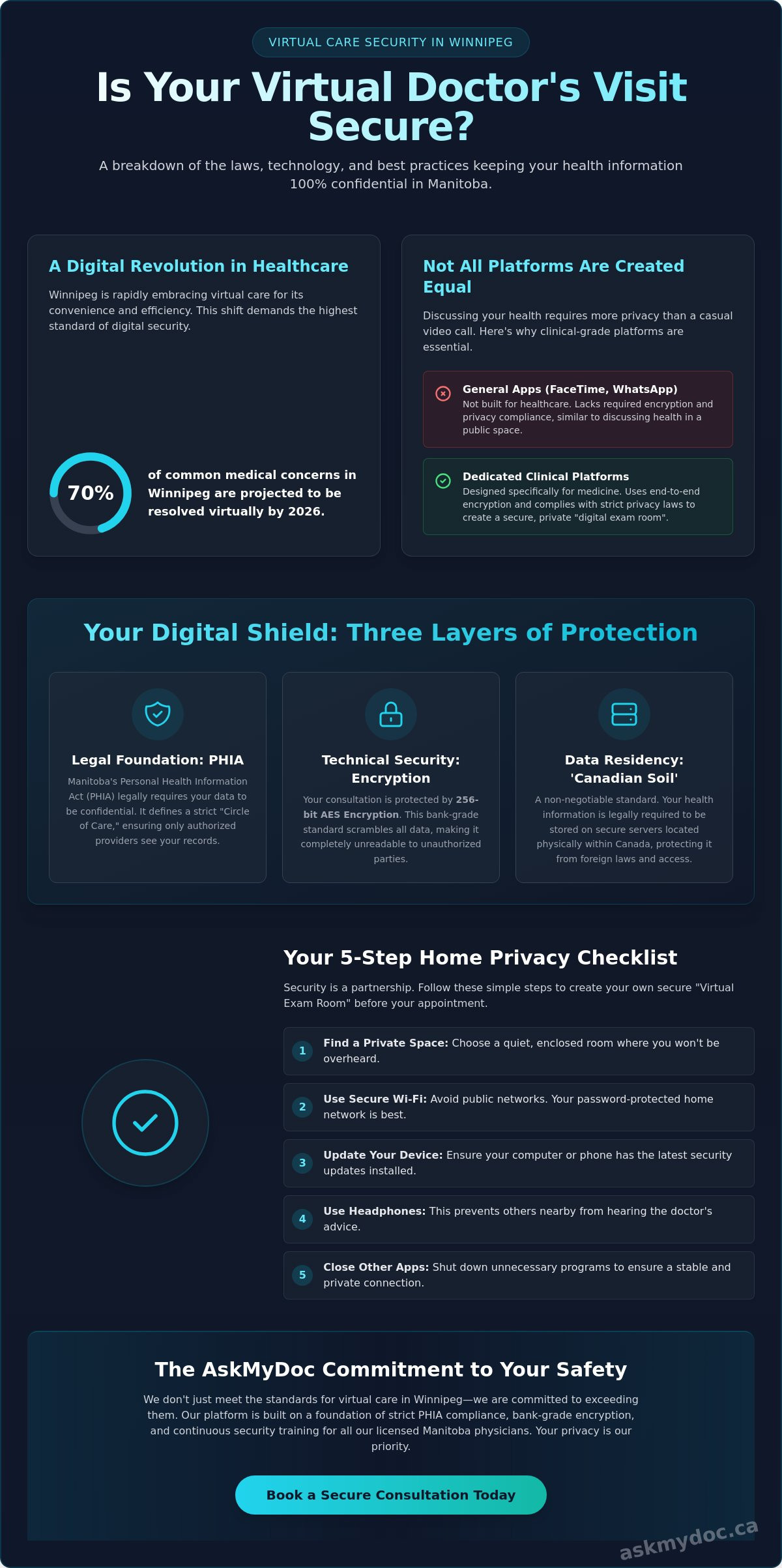
Winnipeg has seen a massive shift in how we access care. Today, virtual care handles over 70% of common medical concerns in the city. This growth is driven by both busy families and seniors who prefer the comfort of home. Shared Health Manitoba plays a vital role here by setting the benchmarks that all providers must follow. These standards are grounded in Manitoba’s privacy laws, which dictate how public and private entities handle your sensitive information. Public perception has followed suit. Most Winnipeggers now trust digital platforms because they offer a controlled environment where professional help is always readily available. They appreciate the speed and the fact that their data doesn’t have to travel on paper between clinics, reducing the risk of lost files.
The Legal Foundation: PHIA and Manitoba Privacy Laws
Every time you speak with a doctor online, a robust legal framework works behind the scenes to protect you. In Manitoba, this foundation is built on The Personal Health Information Act (PHIA). This specific legislation dictates exactly how your medical data is collected, stored, and shared. It’s the primary reason why the answer to “is virtual care in winnipeg secure” is a firm yes. One of the most important concepts within this law is the “circle of care.” This rule ensures that only healthcare providers directly involved in your treatment can access your records. It prevents unauthorized individuals from browsing your medical history, keeping your sensitive information strictly between you and your care team.
The law isn’t just a set of suggestions; it carries heavy weight. Recent amendments to PHIA have strengthened the authority of the Manitoba Ombudsman and introduced mandatory notifications for any privacy breach that poses a risk of serious harm. For patients, this means that every virtual care provider in Winnipeg is legally bound to maintain rigorous security standards. These regulations ensure that your digital records are handled with the same level of confidentiality as a physical file in a locked cabinet. At AskMyDoc, we strictly adhere to these provincial regulations for every virtual consultation. Our platform is designed to meet these requirements, ensuring that your digital journey is as safe as an in-person visit. If you’re ready to experience this level of protected care, you can easily book a consultation online with a licensed Manitoba physician.
How PHIA Protects Your Virtual Visit
Your protection starts before the doctor even appears on your screen. Under PHIA, physicians must obtain your informed consent before a virtual session begins. They’re required to explain how the technology works and any potential privacy risks. You also have the right to access and audit your own digital health logs. This means you can see exactly who has viewed your information and when. To ensure this data remains locked, physicians must use secure, authenticated login processes. These multi-step verifications ensure that only the right doctor is entering your private virtual exam room.
Secure Billing and Your Manitoba Health Card
A common concern for many Winnipeggers is how their Manitoba health card information is handled. When you provide your card details for a virtual visit, that data is transmitted to Manitoba Health using high-level encryption protocols. Unlike traditional paper-based clinic systems where files might be left on a desk or in an unlocked cabinet, digital billing is strictly controlled. Every insurance claim is processed through a secure gateway, reducing the risk of human error or physical theft. This digital-first approach ensures that your provincial billing information is shielded from the moment you enter it until it reaches the health authority.
Technical Safeguards: Encryption and the ‘Canadian Soil’ Rule
While laws provide the framework for privacy, technology provides the actual shield. To truly understand if is virtual care in winnipeg secure, you have to look at the specific protocols used to move your data across the internet. Professional platforms use 256-bit AES encryption, which is the same standard used by global financial institutions and the military. It acts like a digital vault. Even if someone were to intercept the signal between your home and the doctor’s office, they’d find nothing but scrambled, unreadable code. This end-to-end protection is essential for preventing “Man-in-the-Middle” cyber attacks, where a third party tries to “listen in” on a private connection.
Accountability is another technical pillar. Clinical systems maintain detailed audit trails that record every single interaction with your medical file. These logs track exactly who accessed your information, what they viewed, and when they did it. This level of transparency is a core requirement under Manitoba’s Personal Health Information Act (PHIA). Unlike a paper file that might be left on a desk, a digital record on a secure platform never moves without leaving a footprint. This ensures that your information stays within the authorized “circle of care” we discussed earlier.
The Problem with Skype, FaceTime, and WhatsApp
Many people use FaceTime or WhatsApp for daily chats, but these consumer apps aren’t suitable for healthcare. They don’t meet the clinical security requirements set by Manitoba health authorities. Large tech corporations often mine data from free apps to build user profiles, which is a major risk for sensitive medical history. Furthermore, these apps lack the professional liability features and audit logs required for medical practice. If a privacy issue occurs on a consumer app, there’s often no way to track the source or hold anyone accountable. Professional platforms are built from the ground up to avoid these vulnerabilities.
Data Residency and Winnipeg Patients
Where your data physically lives matters just as much as how it’s encrypted. This is known as the “Canadian Soil” rule. If your medical information is stored on servers in the United States, it falls under U.S. legal jurisdictions, such as the Patriot Act. This could potentially allow foreign government agencies to access your records without your knowledge. AskMyDoc ensures that all Winnipeg patient data remains on secure servers located right here in Canada. Our data centers use advanced physical security, including biometric access and 24/7 monitoring, to protect the hardware itself. By keeping your data on Canadian soil, we ensure it remains protected by our own strict privacy laws.
A Patient’s 5-Step Privacy Checklist for Home Visits
While the technical infrastructure we’ve discussed provides a military-grade shield, security is a shared responsibility. The platform handles the digital vault, but you control the room where the conversation happens. To guarantee that is virtual care in winnipeg secure during your specific session, you should follow a simple protocol. Think of your home environment as a temporary clinic space that requires the same standards of privacy you’d expect in a hospital. Even the strongest encryption can’t prevent someone in your own house from overhearing a sensitive conversation.
Start with device hygiene. Ensure your smartphone or laptop is running the latest security updates before you log in. Outdated software often has vulnerabilities that malware can exploit to record screens or log keystrokes. A clean device is your first line of defense. Once your hardware is ready, follow these five essential steps to lock down your side of the screen:
- Verify your device: Use a personal device rather than a shared or work computer.
- Secure your space: Find a room with a door to prevent eavesdropping.
- Check your connection: Use private, password-protected WiFi only.
- Manage smart tech: Mute any voice-activated home assistants.
- Post-visit cleanup: Clear your browser cache or close the secure app immediately.
Setting Up Your Private Space
Physical privacy is just as important as digital encryption. Choose a room with a door you can close to keep family members or roommates from accidentally overhearing your medical history. Using headphones is another simple way to keep the doctor’s voice private. It prevents sound from traveling through walls or open windows. Don’t forget about your smart home devices. Virtual assistants like Alexa or Google Home are designed to listen for wake words. Mute these devices or move them to another room during your call to ensure your consultation isn’t inadvertently recorded by a third-party cloud service.
WiFi and Connection Security
Your internet connection is the bridge between you and your provider. You should never use public WiFi at a coffee shop or library for a virtual healthcare winnipeg appointment. These open networks are often unencrypted, making it easy for hackers to see your traffic. Instead, use your home network and verify it is password-protected using WPA2 or WPA3 encryption. If you aren’t at home, a cellular data connection is significantly more secure than an unsecured hotspot. After your visit, clear your browser history or close the app entirely to remove any temporary files. Taking these small steps allows you to start your virtual consultation with the confidence that your privacy is protected from every angle.
The AskMyDoc Commitment to Winnipeg’s Safety
At AskMyDoc, we believe that high-quality healthcare is impossible without absolute privacy. We treat your digital security with the same gravity that a traditional surgeon treats a sterile operating room. While the technology we use is cutting-edge, our values are rooted in the fundamental ethics of the medical profession. Patients often ask, is virtual care in winnipeg secure when using our specific platform? Our answer is a definitive yes, backed by a system designed to exceed provincial requirements. We don’t just provide a video link; we provide a secure gateway to professional medical support that respects your time and your autonomy.
Transparency is a cornerstone of our commitment. We are clear about how your data is handled and who has access to it. From the moment you book a consultation to the point of getting a prescription online in Manitoba, every step is shielded by the encryption protocols we’ve detailed in this guide. Our platform ensures that your sensitive information, including lab orders and sick notes, is delivered directly to you or your pharmacy through protected channels. This eliminates the risks associated with lost paper documents or unencrypted email attachments.
Vetted Physicians You Can Trust
The security of a platform is only as strong as the people who use it. Every doctor on the AskMyDoc platform is a licensed Manitoba physician in good standing with the College of Physicians and Surgeons of Manitoba (CPSM). We conduct a rigorous verification process for every provider to ensure they meet our high standards for clinical excellence. Beyond their medical credentials, our staff undergoes mandatory, ongoing training in PHIA compliance and digital privacy best practices. This ensures that the professional on the other side of your screen is not just an expert in medicine, but also a guardian of your personal data. This dual focus on care and confidentiality provides a level of reliability that matches the traditional doctor-patient relationship.
Ready to Book Your Secure Appointment?
Taking control of your health shouldn’t be complicated or stressful. We have streamlined our process into three simple, secure steps. First, you provide your basic information and the reason for your visit. Second, you are matched with a local doctor. Finally, you attend your secure video consultation. This efficient rhythm reflects the on-demand nature of our service, with 95% of our Winnipeg patients receiving a consultation within four hours of their request. Whether you need to ask a doctor a quick question or require a formal diagnostic order, you can expect a professional experience that prioritizes your safety. Book your secure appointment today and experience the modern ease of protected, local healthcare.
Secure Your Health with Confidence
Protecting your medical privacy is a collaborative effort between advanced technology and informed choices. You now understand that robust legislation like PHIA and the strict “Canadian Soil” rule for data residency work together to keep your information within our provincial borders. When you combine these clinical-grade safeguards with your own secure home connection, the answer to is virtual care in winnipeg secure is a resounding yes. You no longer need to sacrifice your privacy for the sake of convenience.
AskMyDoc remains committed to providing Winnipeggers with a safe, reliable gateway to professional medical support. Our platform is PHIA compliant, utilizes 256-bit encryption, and ensures all data is stored on Canadian soil. Best of all, our services are free with your Manitoba Health Card. Don’t let uncertainty hold you back from the care you need. Take the next step toward a more efficient and protected healthcare experience today.
Book a Secure, Same-Day Virtual Appointment with a Manitoba Doctor and see how easy it is to prioritize your well-being without compromising your safety.
Frequently Asked Questions
Is my virtual doctor visit recorded?
No, your virtual consultation is never recorded by the platform or the physician. Privacy laws in Manitoba require that digital sessions remain as transient as an in-person conversation. While the doctor takes clinical notes to update your medical file, the video and audio stream itself is not saved. This ensures that your private discussion remains strictly between you and your provider without leaving a digital footprint of the conversation.
Can someone hack into my video call with the doctor?
It is nearly impossible for an unauthorized person to intercept your call. We use 256-bit AES encryption, which creates a secure, end-to-end tunnel for your data. This level of protection is the global standard for financial and medical institutions. Because each session uses a unique, encrypted link, “is virtual care in winnipeg secure” from hackers is a question answered by high-level technical barriers that prevent eavesdropping.
Where is my medical information stored after the visit?
Your medical records are stored on secure, encrypted servers located physically within Canada. This follows the “data residency” principle, ensuring your information is only subject to Canadian privacy laws. These data centers use biometric access and 24/7 monitoring. By keeping data off foreign servers, we prevent it from being accessed by international agencies or falling under less stringent privacy jurisdictions that might exist outside of our borders.
Do I need special software to have a secure appointment?
You don’t need to download specialized software to access our secure platform. Most appointments happen through a standard, updated web browser on your phone or laptop. The security is built into the web interface itself. We recommend using the latest version of Chrome, Safari, or Firefox to ensure all encryption protocols are fully active and to provide the smoothest, most reliable video experience during your consultation.
How does the doctor verify my identity online?
Verification is a multi-step process designed to ensure patient safety and data integrity. You will be asked to provide your Manitoba Health Card number and a piece of government-issued photo ID during the registration process. The doctor reviews these documents at the start of the call to confirm they are speaking with the correct individual. This prevents medical identity theft and ensures that prescriptions or sicknotes are issued to the right person.
What happens if my internet disconnects during a sensitive discussion?
If your connection drops, the doctor will immediately try to reconnect through the secure platform. If the internet issue persists, they will call the phone number provided in your profile to finish the consultation. Your safety and the continuity of your care are the primary priorities. We always have a backup plan in place to ensure your medical needs are addressed without delay, regardless of technical interruptions.
Is it safer to see a doctor online or at a walk-in clinic?
Both methods are highly secure, but virtual care offers unique privacy advantages. You don’t have to sit in a public waiting room where others might see you or overhear your check-in details. Online consultations happen in the privacy of your own home, reducing the risk of physical file mishandling. For many Winnipeggers, the digital environment feels more controlled and confidential than a traditional, busy walk-in clinic setting.
Does AskMyDoc share my data with third-party advertisers?
No, we never share or sell your personal health information to third-party advertisers. Your data is used exclusively for your medical care and provincial billing purposes as required by law. We operate under strict ethical guidelines that prioritize patient confidentiality over any commercial interests. Your trust is our most valuable asset, and we protect it by maintaining a platform entirely free from data mining or external marketing practices.