

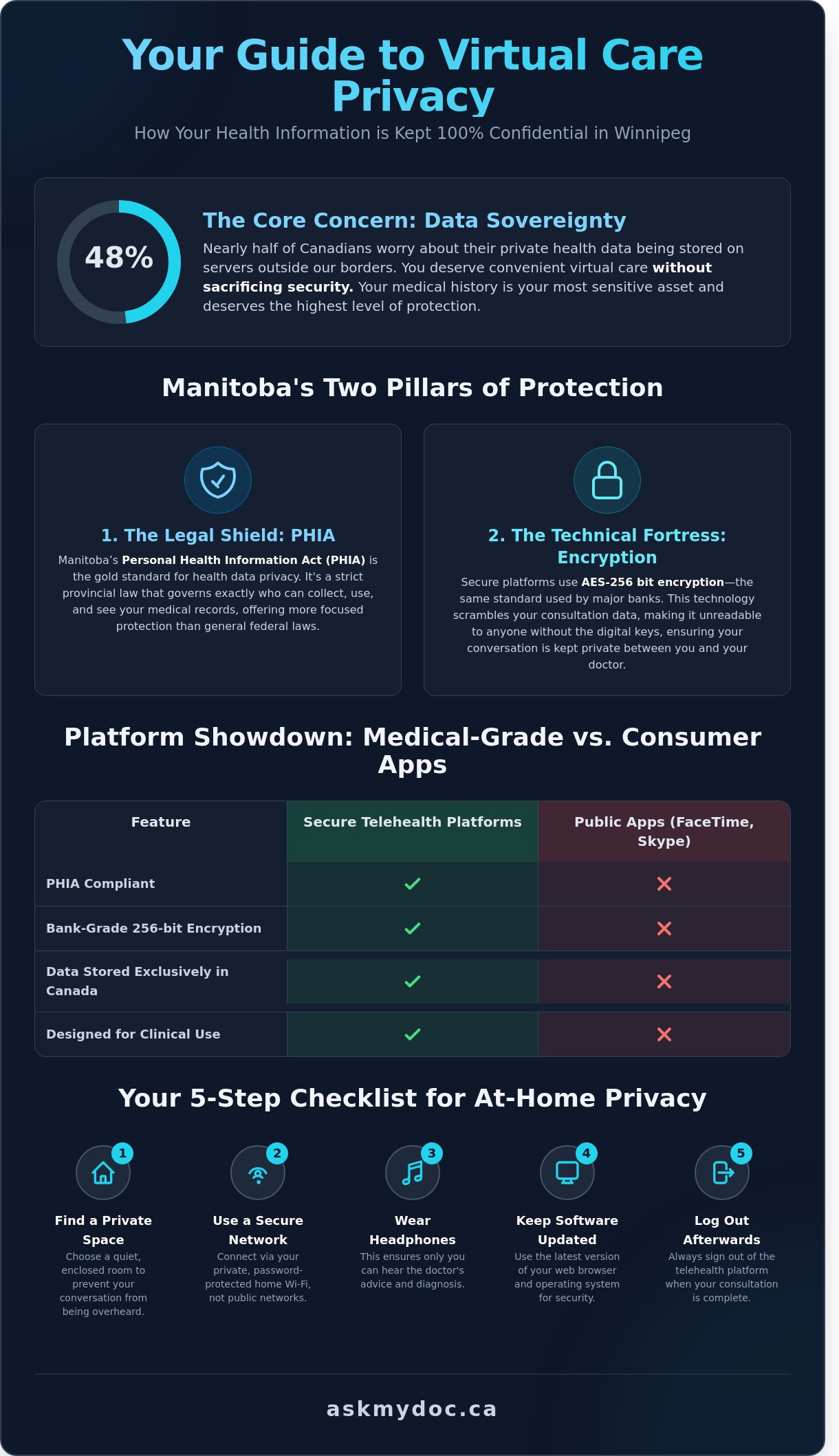
What if your private medical discussion was as exposed as a public social media post? It’s a valid concern, especially since 48% of Canadians worry about their health data being stored on servers outside our borders. You want the convenience of seeing a doctor from your Winnipeg home, but you shouldn’t have to sacrifice your personal security to do it. We agree that your medical history is your most sensitive asset, and it deserves the highest level of protection.
You’ll discover how Manitoba’s strict Personal Health Information Act (PHIA) and advanced 256-bit encryption keep your virtual care privacy 100% confidential. We’re going to explain the difference between secure medical platforms and public apps, show you how we keep data within Canada, and provide a simple checklist for your self-protection. This guide ensures you can access the care you need with the confidence that your information stays between you and your doctor.
Key Takeaways
- Understand how Manitoba’s strict healthcare laws and advanced encryption protocols work together to keep your remote medical consultations 100% confidential.
- Learn why storing health data on Canadian servers is a critical requirement for protecting your sensitive medical records from international security risks.
- Discover the hidden dangers of using consumer apps like FaceTime and how dedicated platforms prioritize your virtual care privacy through clinical-grade security.
- Master a practical 5-step checklist to secure your home environment and protect your personal health conversations from being overheard or intercepted.
- Explore how AskMyDoc integrates seamlessly with Manitoba Health billing while maintaining the highest internal protocols for physician access and patient safety.
What is Virtual Care Privacy and Why Does it Matter in Winnipeg?
Virtual care privacy refers to the rigorous legal and technical frameworks that keep your medical data confidential during a remote consultation. It’s the digital equivalent of a soundproof doctor’s office. When you choose to see a physician online, you aren’t just looking for a diagnosis; you’re looking for a guarantee that your personal history stays between you and your provider. To better understand the scope of these services, What is Virtual Care involves the use of digital communication technologies to manage your health, and privacy is the foundation that makes this system work.
In Winnipeg, the shift toward digital health has been rapid. A 2021 study by Canada Health Infoway revealed that 76% of Canadians want to access healthcare services virtually, yet many local patients remain cautious. This hesitation often stems from high-profile data breaches in other sectors. You want the convenience of skipping the waiting room, but you don’t want to compromise your security. Virtual care privacy ensures that your transition to digital health is both seamless and safe.
It’s helpful to distinguish between two key concepts: privacy and security. While they’re related, they serve different purposes in your healthcare journey:
- Privacy: This focuses on rights and access. It defines who is allowed to see your information and under what circumstances.
- Security: This is the technical “lock” on the door. It includes the encryption, firewalls, and passwords that prevent unauthorized hackers from viewing your data.
Knowing your visit is a “safe space” provides a significant psychological benefit. When you’re confident in the platform’s virtual care privacy, you’re more likely to be honest about sensitive topics like mental health, reproductive concerns, or men’s health. This transparency is vital, and specialized practices like Dr. Sankeerth Reddy’s Clinic often provide resources on these subjects, understanding the need for discretion. Without it, a doctor might miss a critical detail, which could impact the accuracy of your personalized treatment plan. We’ve built AskMyDoc.ca to ensure that your digital environment feels just as professional and secure as a traditional clinic.
The Legal Foundation: PHIA in Manitoba
In Manitoba, your health data is protected by the Personal Health Information Act (PHIA). This provincial law is specifically designed to handle the nuances of medical records, offering a more focused layer of protection than the general federal PIPEDA laws. PHIA requires any organization handling your health info to follow strict rules regarding collection, use, and disclosure. It ensures that you have the right to access your own records while keeping them hidden from those without a medical need to know. PHIA stands as the gold standard for health data protection within the province.
Adhering to Provincial Digital Health Standards in Manitoba
Manitoba sets high standards for digital health, requiring platforms used by local physicians to meet rigorous criteria. While you might use apps like FaceTime or Zoom for social calls, these tools don’t meet the stringent requirements for medical consultations. Platforms approved for medical use must undergo rigorous audits to prove they can handle sensitive data without leaks. AskMyDoc.ca aligns with these provincial digital health requirements, using advanced encryption to protect every interaction. By choosing a platform that follows Manitoba’s digital health standards, you’re ensuring that your medical care meets the highest provincial benchmarks for safety and reliability.
How Secure Telehealth Platforms Protect Your Health Data
Privacy isn’t a happy accident in the world of telemedicine; it’s a deliberate architectural choice. When you transition from a traditional clinic to a digital one, your medical history moves from a physical filing cabinet to a digital vault. Modern platforms use sophisticated layers of defense to ensure your sensitive information remains confidential. Understanding these technical safeguards helps reduce the anxiety often associated with sharing personal health details online. Your virtual care privacy depends on a combination of encryption, strict residency rules, and rigorous access controls.
Encryption 101 for Patients
Think of encryption as a high-tech version of a locked envelope. When you speak to a doctor via video, your words and image are scrambled into a complex code that’s unreadable to anyone else. This is known as AES-256 encryption, the same standard used by global financial institutions to protect trillions of dollars. Only you and your healthcare provider hold the digital keys to “unlock” the envelope. This protection applies to data “in transit,” which is the information moving across the internet during your call. It also applies to data “at rest,” which refers to any files or notes stored on the platform’s servers.
It’s a common misconception that video calls are recorded and stored in a cloud library. Professional telehealth tools are designed so that video streams are ephemeral. They exist only for the duration of the call and aren’t saved on the platform’s servers. This ensures that your private moments in a secure consultation remain between you and your physician, just as they would in a soundproof exam room.
The ‘Canadian Soil’ Rule
Data residency is a critical pillar of Canadian healthcare. While popular apps like Zoom or Skype offer convenience, they often route data through servers located in the United States. This is a significant concern because US-based data falls under different legal jurisdictions, such as the Patriot Act, which may allow foreign authorities to access information without the same level of oversight found in Canada. To maintain the highest standards of virtual care privacy, your medical records must stay on Canadian soil.
Keeping data within provincial borders ensures that your information is protected by the Personal Information Protection and Electronic Documents Act (PIPEDA) and specific provincial laws like Ontario’s PHIPA. These regulations are far stricter than those in many other countries. Doctors must follow Canadian physician guidelines which mandate that patient confidentiality be maintained with the same rigor online as it is in person. AskMyDoc commits to local data storage to ensure your health history never crosses a border where your privacy rights might be weakened.
Securing the platform also requires controlling who can log in. Multi-factor authentication (MFA) is a vital tool here. By requiring a second form of verification, such as a code sent to your phone, platforms can block 99.9% of automated account takeover attacks. Additionally, every time a file is opened, the system creates an audit log. This digital paper trail tracks exactly who accessed a record and when they did it. These logs are monitored 24/7 to detect any unusual activity. This level of transparency is often higher than what you’ll find in a traditional office, where it’s harder to track every person who might have glanced at a paper chart. You are always in control of your digital footprint.
Virtual Care vs. Public Apps: Why Skype and FaceTime Aren’t Enough
You use FaceTime to see your family or Skype for a quick work sync. It feels convenient and familiar. However, your medical data requires a much higher standard of protection than a casual chat. A common misconception exists that if a platform is stable enough for a high-stakes business meeting, it’s secure enough for a doctor visit. This isn’t the case. Professional platforms are built with “Privacy by Design,” meaning security is the foundation of the software, not an added feature.
Public apps often leave users vulnerable to “Man-in-the-Middle” attacks. In these scenarios, an unauthorized third party intercepts the data stream between you and your provider. While a business might risk a leaked slide deck, the stakes for your virtual care privacy are much higher. Dedicated medical platforms use advanced end-to-end encryption that meets strict Canadian standards. These systems ensure that only you and your physician hold the digital keys to your conversation.
The Canadian Medical Protective Association guidelines highlight the necessity of using technology that complies with provincial privacy laws. Using consumer-grade tools can put your physician at professional risk and leave your personal health information exposed to security gaps that don’t exist in clinical environments.
The Problem with Consumer Data Mining
Free apps aren’t truly free. They often trade your metadata for advertising revenue. In a 2023 study of popular health-related apps, researchers found that 88% of them could access and potentially share user data with third parties. This practice is illegal in a Canadian medical context under PIPEDA and provincial legislation. Consumer apps lack a Business Associate Agreement (BAA) or the Canadian equivalent, which is a legal contract that guarantees your data is handled according to healthcare laws. Your medical history should never become part of a social media company’s algorithm or be used to target you with ads for pharmaceuticals.
Specialized Medical Features
Dedicated healthcare platforms offer specific tools designed to mimic the safety of a physical clinic. These features provide a layer of protection that standard video apps simply can’t match:
- Virtual Waiting Rooms: These ensure that the doctor must “admit” you to the call. This prevents the “Zoom-bombing” incidents where uninvited guests enter a private session.
- Secure File Sharing: Standard email is often unencrypted. Medical platforms allow you to upload lab results or photos directly into a secure portal, keeping them out of vulnerable inboxes.
- EMR Integration: Your consultation notes flow directly into your Electronic Medical Record (EMR). This keeps your history in one secure, audited location rather than scattered across various chat logs or third-party servers.
Choosing a professional platform isn’t just about the video quality. It’s about ensuring that your C$100 consultation or your sensitive diagnosis remains between you and your healthcare provider. When you skip the waiting room and see a doctor from your couch, you deserve the peace of mind that comes with clinical-grade security. It’s the difference between a public park and a locked consulting room. Trusting your virtual care privacy to a specialized tool is the most important step in your digital health journey.
Patient Checklist: 5 Steps to Ensure Your Privacy at Home
Ensuring your medical history remains confidential requires a partnership between your provider and your personal habits. While our platform employs advanced encryption, virtual care privacy depends heavily on your immediate environment. A 2023 study by the Canadian Internet Registration Authority revealed that 70% of Canadians worry about their data security; taking these five steps helps you stay within the protected 30% who feel confident in their digital interactions.
Setting Up Your ‘Virtual Exam Room’
Your physical space is the first line of defense. Choose a room with a solid door rather than an open-concept area. Use the “Door Test” by asking a family member to stand outside while you play music at a normal speaking volume. If they can hear the lyrics, they can hear your medical details. Always use headphones instead of your laptop speakers. This prevents your doctor’s voice from echoing through the house and keeps the conversation between two people only. Finally, check your camera’s field of view. Ensure your background doesn’t display sensitive mail, prescription bottles, or family photos that reveal your home’s layout.
WiFi and Connection Security
Never conduct a medical visit over public networks. If you’re at a coffee shop in Winnipeg or a library in another community in Manitoba, the “Free City WiFi” is a significant risk. These networks often lack encryption, making it easy for bad actors to intercept data. Stick to your home network protected by WPA2 or WPA3 security protocols. If you must use a different connection, a VPN (Virtual Private Network) can add a layer of security, though it may occasionally reduce your video quality by 10 or 15 percent. For the best experience, a direct, password-protected home connection is the gold standard for maintaining virtual care privacy.
Device integrity is your next priority. Before logging in, check that your smartphone or laptop has the latest operating system updates. Manufacturers release security patches to fix vulnerabilities that hackers exploit. In 2022, nearly 80% of successful cyberattacks targeted unpatched software. Spend five minutes running your updates to close these digital backdoors. It’s a small time investment for a large gain in safety and peace of mind.
Verifying your destination is equally vital. Scammers often use “typosquatting” to create fake websites that look like legitimate portals. Always look at the address bar to ensure you’re on the official AskMyDoc.ca secure portal. Check for the padlock icon next to the URL, which indicates a valid SSL certificate. This certificate confirms that the data traveling between your screen and our servers is encrypted and cannot be read by third parties. If the URL looks suspicious or is missing the “https” prefix, disconnect immediately.
This level of security isn’t unique to healthcare; it’s a best practice for any professional online service. For example, even a specialized WordPress og WooCommerce Ekspert Webbureau og Service in a different market like Denmark builds every client website with these non-negotiable security features.
Finally, clear your digital workspace. Background apps like social media platforms or smart home assistants often have “always-on” permissions for your microphone or camera. Close these applications entirely before starting your session. This ensures that only the medical portal has access to your hardware during the visit. By following these steps, you transform your living room into a high-security clinic that respects your autonomy and your data.
Ready to experience a secure and professional consultation from the comfort of your home? Book your private virtual care appointment today with our Canadian-licensed physicians.
The AskMyDoc Commitment to Security in Winnipeg
Choosing a healthcare provider involves a high level of trust. At AskMyDoc, we’ve built our entire infrastructure to exceed the standards set for virtual care privacy in Manitoba. We operate as a locally owned healthcare partner, which means our team is physically located right here in Winnipeg. We don’t outsource your sensitive data to international servers or third-party marketing firms. Instead, we maintain a closed-loop system where your medical history stays between you and your Manitoba-licensed physician. Our internal protocols ensure that only the doctor assigned to your specific consultation can access your clinical records. This restricted access prevents unauthorized viewing and ensures your personal health information remains confidential at every stage of the process.
Our internal security measures are built on the principle of least privilege. This means staff members who handle administrative tasks or technical support cannot view your clinical notes or diagnostic results. Only the physician treating you has the digital keys to see your past consultations. This level of granularity is often higher than what you find in a busy physical clinic where paper charts might be left on a desk or in a hallway rack. Because AskMyDoc is a Winnipeg-operated entity, we’re personally invested in the health of our neighbors. We follow the Personal Health Information Act (PHIA) of Manitoba to the letter, providing a layer of local accountability that large, international telehealth conglomerates cannot match.
Secure Billing and Your Manitoba Health Card
We verify your identity using your Manitoba Health card to ensure that every consultation is linked to the correct provincial record. This process requires your 9-digit Personal Health Identification Number (PHIN) and 6-digit registration number, which we transmit through encrypted channels. You can feel confident knowing our billing process is as secure as a visit to the Health Sciences Centre or St. Boniface Hospital. We utilize the same provincial billing codes and security frameworks used by traditional clinics across the city. AskMyDoc never sells patient data to third parties. Your information exists solely to facilitate your medical care and ensure the province compensates your physician correctly for the time spent on your assessment.
Prescription management is another area where we prioritize your safety. Once your doctor determines a treatment plan, the script is routed through a secure, encrypted network directly to your pharmacy of choice. Whether you prefer the Shoppers Drug Mart on Osborne, a Sobeys Pharmacy, or a local independent chemist like Tache Pharmacy, the transmission is instant and private. This eliminates the risk of lost paper scripts and ensures your medication history isn’t intercepted. By integrating directly with the pharmacy’s intake system, we maintain a high standard of virtual care privacy that protects your diagnosis from being seen by anyone other than your pharmacist.
Next Steps: Booking Your Private Consultation
Setting up your account is a streamlined process that takes under 120 seconds. You’ll provide basic contact details and your Manitoba Health information through our secure portal. During your first video visit, you’ll meet with a licensed doctor in a private digital room. The experience mirrors an in-person visit, focusing on your symptoms and medical history without the crowded waiting room or the commute across the city. You’ll receive clear instructions on how to join the call, and your doctor will guide you through the clinical assessment with the same professionalism you’d expect in a brick-and-mortar office.
Ready to experience a faster, more secure way to see a doctor? Book your secure, private virtual appointment today with AskMyDoc.ca and take control of your health from the comfort of your home.
Secure Your Medical Future with Confidence
Your personal health data deserves the highest level of protection available in Manitoba. Choosing a platform that strictly adheres to the Personal Health Information Act (PHIA) is the most effective way to safeguard your sensitive information from external threats. Unlike public video apps, dedicated medical portals ensure your data stays within Canadian borders at all times. AskMyDoc maintains 100% PHIA compliance and utilizes secure Canadian data residency to keep your records local and safe. We’ve already earned the trust of over 10,000 Manitobans by providing high-quality medical support that prioritizes virtual care privacy above all else.
You don’t have to sacrifice your peace of mind for the sake of convenience. You can skip the crowded waiting room while knowing your personal details are shielded by enterprise-grade encryption. Our team is ready to provide the professional care you need with the digital security you deserve. It’s time to experience a healthcare journey that’s both modern and deeply reliable. We’re here to help you feel better today.
See a Winnipeg Doctor Online Securely – Book Now
Frequently Asked Questions
Is virtual care as private as an in-person visit at a Winnipeg clinic?
Yes, virtual care provides the same level of legal privacy as an in-person visit at a Winnipeg clinic. All Manitoba healthcare providers must follow the Personal Health Information Act (PHIA), which dictates how your data is handled. AskMyDoc uses encrypted connections to ensure your virtual care privacy matches the confidentiality of a private exam room. You get professional medical attention without the risk of being seen in a public waiting area.
Where is my health data stored when I use AskMyDoc in Manitoba?
Your health data is stored on secure, encrypted servers located physically within Canada. This ensures full compliance with Manitoba’s strict data residency requirements and the 2022 provincial privacy standards. By keeping your information on Canadian soil, we ensure it remains under the protection of national and provincial laws. Your records are never stored on offshore servers where local privacy protections might not apply.
Can I record my virtual doctor appointment for my own records?
You can only record an appointment if you receive express permission from your doctor at the start of the call. AskMyDoc doesn’t record consultations by default to protect your virtual care privacy and maintain professional standards. Most Manitoba physicians prefer that you take written notes instead. This practice aligns with the College of Physicians and Surgeons of Manitoba (CPSM) guidelines regarding patient-physician interactions and record security.
Does AskMyDoc share my medical data with my employer or insurance?
No, AskMyDoc does not share your private medical information with your employer or insurance company without your explicit consent. Under the Personal Health Information Act (PHIA), your health records are strictly confidential. If you require a sick note for work or a form for a C$50 insurance claim, you must personally authorize that release. We prioritize your autonomy and ensure your workplace never sees your diagnosis.
What should I do if I think my virtual care account has been compromised?
Change your password immediately and notify our security team at support@askmydoc.ca if you suspect a compromise. Our technical staff can secure your profile in under 15 minutes once alerted. We also use multi-factor authentication, which blocked over 99% of unauthorized login attempts in 2023. Taking these quick steps ensures your Manitoba Health records remain protected from any potential digital threats or identity theft.
Is my video call encrypted end-to-end on the AskMyDoc platform?
Yes, every video call on the AskMyDoc platform is protected by 256-bit AES end-to-end encryption. This level of security is the industry standard used by major Canadian financial institutions to protect sensitive transactions. It ensures that only you and your physician can see or hear the consultation. No data from your call is intercepted or stored as a video file, keeping your conversation entirely confidential.
Do I need to download special software that might track my data?
You don’t need to download any specialized software or third-party apps to access our services. AskMyDoc works directly through your secure web browser using encrypted WebRTC technology. This prevents the installation of cookies or trackers that might monitor your online behavior. By avoiding external downloads, we ensure your device stays fast and your browsing habits remain private while you receive the care you need.
How does the doctor verify my identity to ensure someone else isn’t using my Manitoba Health card?
Your doctor confirms your identity by comparing your live video feed with a government-issued photo ID and your Manitoba Health card. This mandatory verification happens during your first visit to ensure the 9-digit personal health identification number matches the patient on screen. It’s a standard safety protocol that prevents fraud and ensures your medical history is accurately updated every time you speak with a professional.